NZ Superannuation: Eligibility & How to Apply

Turning 65 marks a significant milestone for many Kiwis, bringing the promise of financial security through New Zealand Superannuation (NZ Super). But it's not automatic—you need to meet specific NZ s...
The Lifetimes NZ editorial team curates, fact-checks, and updates guides on personal finance, property, health, immigration, legal, business, and lifestyle topics relevant to Lifetimes NZ readers. Articles are produced with AI assistance and reviewed by the editorial team before publication.
Turning 65 marks a significant milestone for many Kiwis, bringing the promise of financial security through New Zealand Superannuation (NZ Super). But it's not automatic—you need to meet specific NZ superannuation eligibility criteria and apply to start receiving this universal payment that supports over 800,000 seniors annually.
Whether you're approaching 65, planning ahead, or helping a whānau member, understanding the rules ensures you don't miss out. In this guide, we'll break down the exact requirements, application process, payment rates for 2026, and tips to maximise your retirement income—all tailored for New Zealanders.
Who Qualifies for NZ Super? Understanding NZ Superannuation Eligibility
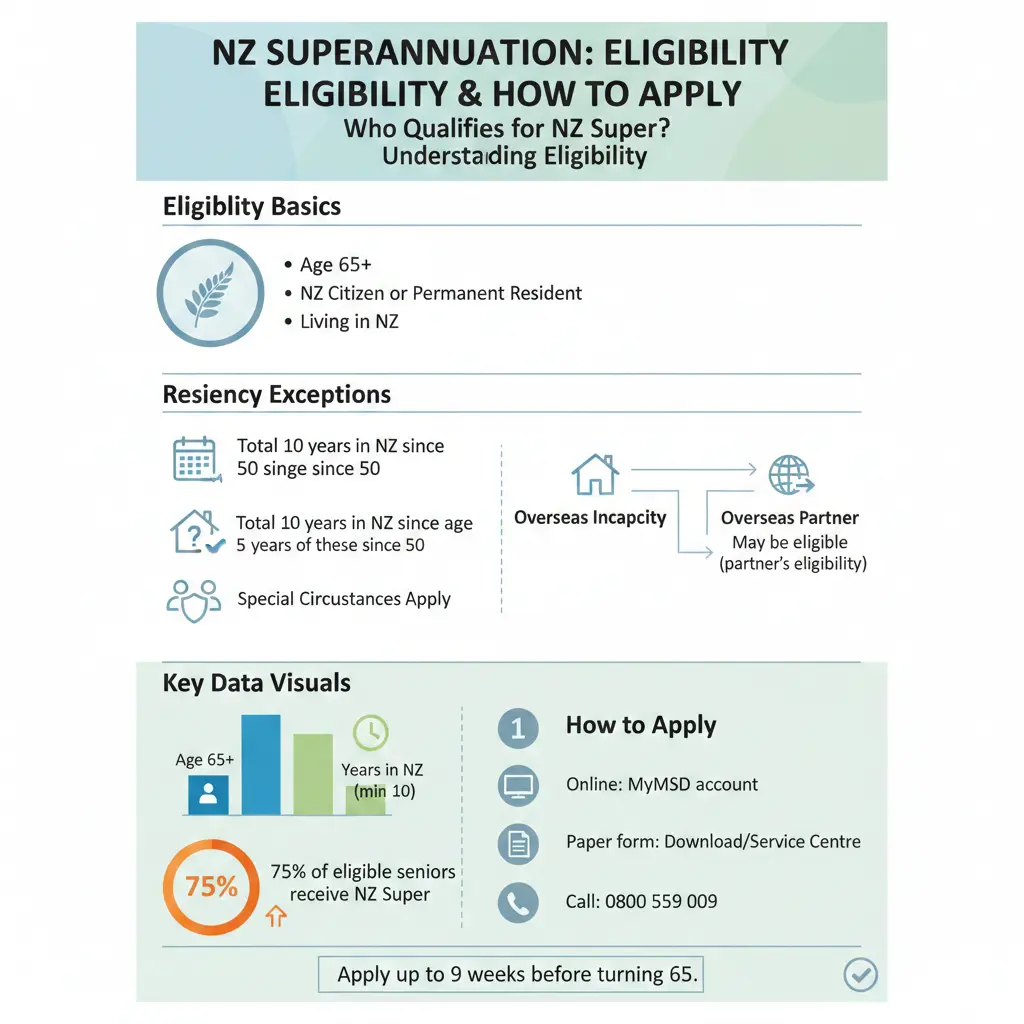
To get NZ Super, you must tick all these boxes:
- Age: Be 65 or older. There's no upper limit, and New Zealand has no mandatory retirement age, so you can keep working if you wish.
- Citizenship or residency: Be a New Zealand citizen, permanent resident, or hold a New Zealand residence class visa.
- Current residency: Be ordinarily resident in New Zealand, the Cook Islands, Niue, or Tokelau when you apply.
- Residence history: Have lived in New Zealand for a required number of years since age 20, including at least 5 years since age 50. These years don't need to be consecutive, but you must have been both resident and physically present.
The Residence Years Table: How Many Years Do You Need?
Your required years depend on your date of birth. For those born on or after 1 July 1977 (turning 65 in 2042 or later), it's a full 20 years. Here's the full breakdown:
| Date of Birth | Total Years Required from Age 20 (Including 5 Years from Age 50) |
|---|---|
| On or before 30 June 1959 | 10 years |
| 1 July 1959 – 30 June 1961 | 11 years |
| 1 July 1961 – 30 June 1963 | 12 years |
| 1 July 1963 – 30 June 1965 | 13 years |
| 1 July 1965 – 30 June 1967 | 14 years |
| 1 July 1967 – 30 June 1969 | 15 years |
| 1 July 1969 – 30 June 1971 | 16 years |
| 1 July 1971 – 30 June 1973 | 17 years |
| 1 July 1973 – 30 June 1975 | 18 years |
| 1 July 1975 – 30 June 1977 | 19 years |
| On or after 1 July 1977 | 20 years |
Example: If you were born on 28 March 1961, you need 11 years from age 20, including 5 from age 50. Short trips overseas might not count, but longer absences could reduce your tally—check Work and Income's definition of 'lived in NZ'.
Special Cases for NZ Superannuation Eligibility
- Not enough NZ years? You can count time in countries with Social Security Agreements (SSAs) like Australia, Canada, Denmark, Greece, Ireland, Jersey, Guernsey, Malta, the Netherlands, South Korea, or the UK. NZ realm countries (Cook Islands, Niue, Tokelau) also count.
- Refugees or protected persons: Requirements may be adjusted based on when you arrived in NZ.
- Overseas now? You might still qualify if you meet criteria and apply from abroad, but use MyMSD only if in NZ.
If you don't qualify at 65, wait until you meet the residence rules—NZ Super doesn't have an age cap.
How Much Does NZ Super Pay in 2026?
NZ Super rates adjust annually for inflation and wages—check Work and Income for the latest. In 2026, expect these approximate fortnightly gross rates (before tax):
- Single, living alone: Around $NZD 1,200+ (10% higher for extra costs).
- Single, sharing with others: Around $NZD 1,100.
- Couple (both qualify): About $NZD 840 each.
- Half couple (partner doesn't qualify): About $NZD 420 (half the couple rate).
Rates rise if your partner is hospitalised over 13 weeks or in residential care—you'd shift to single living alone/sharing. It's taxable via IRD, but most recipients get it net after PAYE. SuperGold card perks (free transport, discounts) come with eligibility.
Step-by-Step: How to Apply for NZ Super
You must apply—it's not automatic. Time it right:
- Check eligibility: Use Work and Income's online step-by-step guide.
- When to apply: If your 65th birthday is within 12 weeks, or you're already 65. If you're 64 and more than 12 weeks out, bookmark and return.
- Gather documents: Birth certificate, passport/ID, bank details, proof of address, residence history evidence (passports, visas).
- Apply online: Via MyMSD (my.msd.govt.nz) if in NZ—fastest way. Overseas? Download form or call.
- Wait for decision: Processing takes 4-6 weeks. Payments start from eligibility date.
- Get your SuperGold card: Automatically issued for discounts on fuel, public transport, and more.
Tip: Apply early to avoid gaps. If partnered, both apply separately.
Practical Tips to Maximise Your NZ Super
- Combine with KiwiSaver: Withdraw from 65 alongside NZ Super for a boosted retirement pot.
- Work longer: No need to retire at 65—earnings don't affect NZ Super (unlike some benefits).
- Check extras: Add-ons like Accommodation Supplement, Disability Allowance via Work and Income.
- Tax planning: NZ Super is income-tested for tax; use IRD's retirement calculator.
- Plan for couples: If one partner lacks eligibility, explore SSAs or wait.
For Māori and Pacific whānau, note RRIP research highlights NZ Super's vital role—keeping the age at 65 protects vulnerable groups.
Next Steps for Your NZ Super Journey
Don't leave it to chance—head to Work and Income today to check your NZ superannuation eligibility. Use their online tool, gather your docs, and apply within 12 weeks of 65. Pair it with KiwiSaver withdrawals and SuperGold perks for a comfortable retirement. If unsure, call 0800 552 002 or visit a Work and Income office. You've earned this—secure it now.
Frequently Asked Questions
Sources & References
-
1
Who can get NZ Super - Work and Income — www.workandincome.govt.nz
-
2
Applying for NZ Superannuation | New Zealand Government — www.govt.nz
-
3
You're 65 or older - Community Law — communitylaw.org.nz
-
4
New Zealand Superannuation - Work and Income — www.workandincome.govt.nz
-
5
A guide to the NZ Pension - New Zealand Seniors — www.nzseniors.co.nz
-
6
NZ Super | Retirement Commission Te Ara Ahunga Ora — retirement.govt.nz
-
7
Five things to do if you're retiring in 2026 | RNZ News — www.rnz.co.nz
-
8
How Much Is NZ Superannuation in 2026? [Explained] - Opes Partners — www.opespartners.co.nz
-
9
How Much Money Do I Need to Retire in New Zealand in 2026 — programminginsider.com
Related Articles

Childcare Options and Costs in NZ 2026
Finding the right childcare for your tamariki (children) is one of the biggest decisions you'll make as a parent, and it's often one of the biggest expenses too. Whether you're returning to work after...

Childcare Subsidies & Financial Support in NZ
Raising tamariki in Aotearoa comes with its joys and challenges, especially when balancing work, study, or training with the costs of quality childcare. If you're searching for childcare subsidies NZ...

Best Start Tax Credit: What It Is & Who Qualifies
If you've just had a baby or are planning to start a family, you might be wondering how to make ends meet during those early years. The Best Start tax credit is one of New Zealand's most valuable fami...

Child Support (Child Maintenance) in New Zealand
Navigating separation or shared parenting in New Zealand often brings up questions about child support NZ – that essential financial help ensuring kids get what they need, no matter where they live. W...